
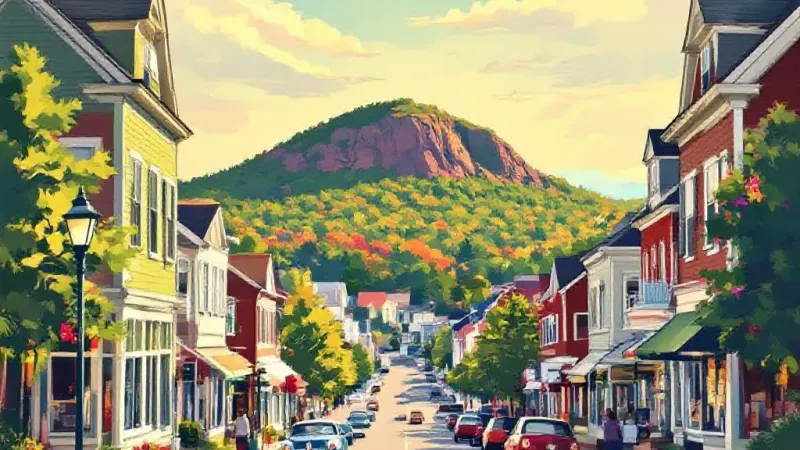
BAR HARBOR — A marker explaining Cadillac Mountain’s sacred significance to the Wabanaki people can no longer be seen at the summit of Acadia National Park. This sign was among 30 markers removed from Acadia, according to the National Parks Conservation Association, under a campaign initiated by the Trump administration to strip national parks of materials deemed disparaging to American history. Interior Secretary Doug Burgum’s orders for the removal have unraveled trust that took decades to build between Acadia National Park and the Wabanaki people.
The Wabanaki Confederacy, known as “the people of the dawnland,” has inhabited the northern seaboard for over 10,000 years, serving as the first known stewards of land that now includes much of Acadia National Park. Cadillac Mountain, known to the Wabanaki in Maine as Wapuwoc, or “white mountain of the first light,” was historically a gathering place for trade, hunting, fishing, and picking sweetgrass. From October to March, it remains the first place to see the sunrise in the continental United States. The removed sign had noted, "Today, visitors from everywhere find meaning on the mountain."
Some of the signs removed from Acadia were developed over years of partnerships with organizations including Friends of Acadia, the Schoodic Institute, and the Native Plant Trust, with consultation from citizens of the Wabanaki Nations. Maulian Bryant, the Wabanaki Alliance’s executive director, stated that getting Wabanaki language and educational material into these parks reflected "the good stuff" and that erasing or setting back this progress "has big implications for how far we’ve come.” Bryant added that these signs did not delve into the more challenging aspects of history, such as disease impact or the reduction in Wabanaki nations.
Beyond Indigenous history, other signs removed from Cadillac’s summit addressed issues of climate change. These informed visitors that "Acadia’s future will be warmer and wetter" and that average annual precipitation had increased by six inches in the last century.
Under the Biden administration, former National Park Service director Chuck Sams and former Interior Secretary Deb Haaland, the first Native Americans to hold these positions, aimed to reflect the experiences of all Americans throughout the national parks. Sams, who served until February 2025, saw portions of his work unraveled by the current administration. Sams characterized this "attempt to rewrite history into a single narrative" as "counter to our democracy. And counter to the idea that we are a plural nation.”
Currently, a coalition of conservation, history, and science organizations is fighting in court to reinstate the Acadia signs and hundreds of other items. According to Angelo Villagomez of the Center for American Progress, a progressive policy group, a leaked database revealed that a third of national parks had flagged exhibits featuring history or science, with Black and Indigenous history being most targeted. Under Interior Secretary Burgum’s 2025 campaign, materials covering topics like slavery, climate change, and the massacre of Native Americans were flagged and removed from national parks and monuments nationwide.
Joy Beasley, a National Park Service associate director, leads a committee reviewing flagged material. However, in a June affidavit, Beasley stated that the internal spreadsheet tracking these changes is “unlikely to capture every removal, revision, or replacement.” The Interior Department did not respond to questions from The Associated Press regarding the status of removals or the ongoing lawsuit.
Todd Martin of the National Parks Conservation Association, a plaintiff in the lawsuit, emphasized that parks "are America’s storytellers" and have a duty to preserve and interpret American history. Jenny McBurney, co-founder of the project Save Our Signs, stressed the importance for park visitors to document revised signs, fearing visitors will learn an "incomplete history."
Despite challenges like job cuts, threats of land reduction, and talks of privatization within some parks, Indigenous groups and park partners have persisted. In Maine, members of the Wabanaki Confederacy, which includes the Maliseet, Mi’kmaq, Passamaquoddy, Penobscot, and Abenaki principal nations, continue cultural traditions and spiritual practices that maintain their connection to ancestral land. This includes sharing their culture with visitors.
Penobscot Nation citizen Jennifer Neptune expressed "mixed emotions" about the attempted erasure of her people from Acadia and their ancestral homeland. Neptune noted the difficulty in securing good signage in national monuments and parks, calling the removal "a real gut punch." She also recognized significant change from the National Park Service over the past decade in bringing Wabanaki voices to the table for Indigenous-designed spaces.
In partnership with Acadia, the privately owned Abbe Museum, largely overseen by Wabanaki people, hosts a program bringing Native voices into the park through music, arts, and culture. As part of this collaboration, Nick Bear and members of a Wabanaki drum circle perform on Cadillac Mountain annually, which Bear described as "bringing those ceremonies right back to the original sites." Passamaquoddy basket maker Lydia Soctomah recently demonstrated traditional Wabanaki basketry at the Sieur de Monts Nature Center, explaining the significance of ash tree and sweetgrass in Wabanaki creation stories. Soctomah shared that "making a basket is worth 1,000 memories for me," and that she was told it "holds a part of your spirit."
Access to sweetgrass, historically difficult for Wabanaki people, has been nearly nonexistent in Acadia since the park’s creation in 1916. Over the past decade, however, park staff and Wabanaki members have collaborated to improve access. In 2017, Suzanne Greenlaw, a scientist and citizen of the Houlton Band of Maliseet Indians, partnered with the U.S. Forest Service, Acadia’s Schoodic Institute, and 14 traditional gatherers for a Wabanaki-led sweetgrass study. Greenlaw found this "really impactful" for establishing co-stewardship relationships, which she noted have endured. By the end of the Biden administration, over 400 co-stewardship or co-management agreements existed with tribes, with 159 within the National Park Service alone, including programs in Acadia. Sams stated these programs allow tribes to fulfill their obligation to protect resources and the federal government to allow tribal access for traditional practices. Sams cautiously hopes for a rebuilding period for the park service under the next administration.